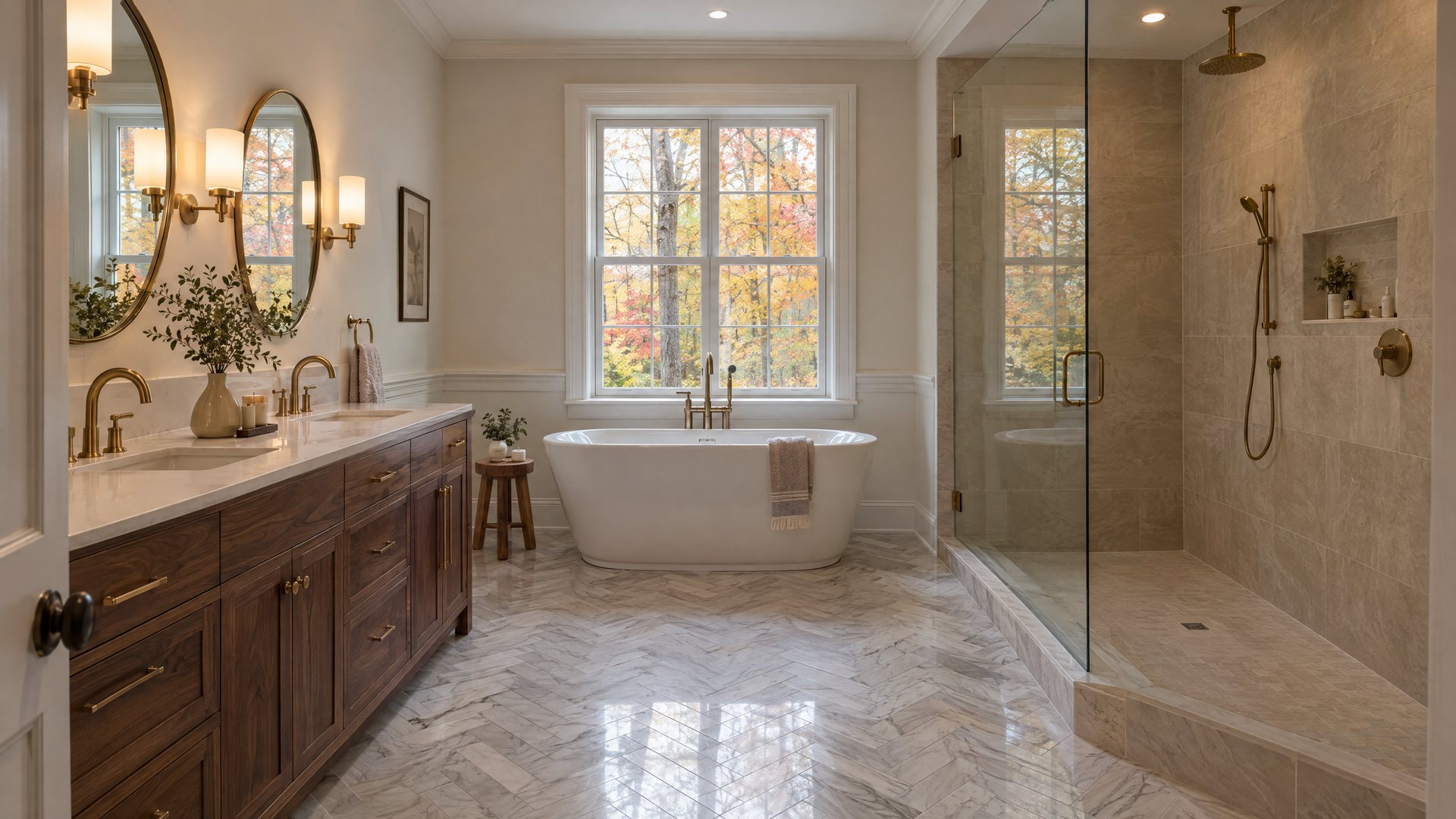
Bathroom Remodeling in New Fairfield, CT
Bathroom remodeling in New Fairfield, CT is a wells-and-septic job almost by definition. Aquarion's New Fairfield System serves about 140 people from wells in town and its other local systems are small community supplies, while Census QuickFacts estimates the town's population at 13,674 as of July 1, 2025, so nearly everyone else draws from a private well. No public sewer serves the town, and Danbury's treatment plant lists New Fairfield only as a source of pumped septage. That changes what we account for in a full bathroom remodel before you choose the first fixture: the water that will run through the new valve, the septic system that will take the drain, and the health review that an added bathroom can trigger.
New Fairfield was incorporated in 1740 and sits on the New York border with Danbury to the south and Sherman to the north, Candlewood Lake along its eastern edge and Squantz Pond State Park inside its 25.1 square miles. The town calls itself a well known summer vacation community, and the seasonal cottages that phrase implies carry their own conversion rule, which we cover below. Town Hall is at 4 Brush Hill Road on Route 39, where the Land Use Department issues the building permits we pull. QuickFacts counts 4,562 households at 2.97 persons each and an owner-occupied rate of 91.7%, and the state's housing appeals list carries a 2020 Census count of 5,635 housing units.
free quotes, fast response, local pros.
Free quote
How we plan a New Fairfield bathroom around the well and the septic field
Aquarion's 2025 report for its New Fairfield System, the groundwater supply serving about 140 people, lists hardness at an average of 9 grains per gallon in a range of 6 to 12, sodium at 19 ppm, chloride at 50 ppm and a pH of 7.4; its other New Fairfield systems are the Ball Pond, Birches, Fieldstone Ridge, Interlaken, Oakwood Acres and Possum Ridge community supplies. Everyone else is on a private well, which the state regulates only by advice. The Department of Public Health estimates 23% of Connecticut residents have private wells and recommends testing for total coliform bacteria, nitrate, nitrite, sodium, chloride, iron, manganese, hardness, turbidity, pH, sulfate, color and odor, plus arsenic, uranium and radon at least once and ideally every 5 years, since 3.9% of the state's private wells exceed the EPA arsenic limit and 4.7% exceed the uranium standard. The results drive what we specify. Iron leaves red-brown stains on porcelain and manganese brown-black ones, so we hold a bathtub replacement in a house with either until treatment is decided, and radon in well water enters the air when the water is heated or agitated.
With no sewer, every New Fairfield bathroom drains to a subsurface sewage disposal system, and Danbury's Sewer Division says its plant accepts septage pumped from New Fairfield tanks. The regional affordable housing plan notes that five of the region's eighteen municipalities have no sewer service and that, without sewers, a minimum lot of one dwelling per two acres was generally necessary to protect water quality. Public Health Code 19-13-B100a, in force since August 3, 1998, is the rule: before a building conversion, a change in use or an addition, the local director of health must determine that a code-complying area exists on the lot for a septic system, and may require the existing system to be expanded when the project raises the design flow by more than 50%. A change in use is any change that lets occupancy rise or that increases the design flow or required leaching area when the building is fully used, which is how an added bathroom lands in health review. A small bathroom remodel where we replace fixtures in place is none of those three, so it stays within the building permit.
We pull the permit from the New Fairfield Building Department, part of the Land Use Department at Town Hall, open Monday through Thursday from 8:30 a.m. to 5:00 p.m. and Friday from 8:30 a.m. to noon, with online permitting for all building permits and a Building Permit Checklist to download. The town's fee schedule, effective April 2025, charges a base amount for the first thousand of construction value and a set rate for each additional thousand or fraction, folds in the state's code education fee of 26 cents per thousand, takes a non-refundable application fee on submission, bills any inspection repeated more than twice, charges to close out a permit older than a year, and values unpermitted work at present costs. The department also enforces the state rule that no permit issues to anyone who must register under the Home Improvement Act unless the registrant's name, business address and Department of Consumer Protection registration number are on the application; ours are. Our permits and inspections guide covers the inspection sequence; the town's page cites the 2022 Connecticut State Building Code and calls unpermitted work dangerous and illegal.
New Fairfield's housing is the most uniform of the towns we serve. The Western Connecticut Regional Affordable Housing Plan, from 2019 American Community Survey figures, counts 5,889 units, of which 5,654, or 96%, are detached single-family houses, with 120 attached units (2%), 53 two-family houses (1%), 43 mobile homes (1%) and nothing in buildings of five or more units. Connecticut History records that Connecticut Light and Power flooded the Big Basin in the 1920s to create Candlewood Lake, the state's largest body of water, and the Candlewood Lake Authority dates its completion to September 29, 1928. A lakeside cottage built for summers becomes a year-round house through what Public Health Code 19-13-B100a calls a building conversion: adding a positive heating supply, a potable water supply protected from freezing, or insulation against heat loss. NOAA's 1991-2020 normals for Danbury put the January mean at 28.0 degrees Fahrenheit with 126 days a year at or below 32 F, and the state's energy checklist requires insulation and an air barrier behind any tub or shower on an exterior wall; in a lake cottage we insulate and seal that wall first.
Costs follow the published ranges on our cost page, with each source named, and the household numbers shift them in two places. At 2.97 persons per household, larger than Danbury's 2.55, Ridgefield's 2.72 or Newtown's 2.82, hot-water demand is the spec we size first: the Department of Energy's Building America guidance sizes a water heater by its first-hour rating rather than tank capacity and counts 20 gallons for a bath, and the hardness result from the well test tells us whether that heater will scale. The second is the well and septic work itself, which no national cost guide prices and which we write into the contract Connecticut's Home Improvement Act requires, alongside the start and completion dates, our registration number and the three-business-day cancellation notice. We keep any up-front payment to no more than the one-third the Department of Consumer Protection advises, and we take it in a traceable form.
See New Fairfield, CT on Google Maps — we cover the whole area from Danbury.
Bathroom Remodeling Services Available in New Fairfield
Bathroom remodeling services in New Fairfield, with the permit we file at the New Fairfield building department
See the full pricing guide for typical ranges.
New Fairfield FAQs
Does my New Fairfield bathroom remodel need a permit?
Yes, unless the work is finish-only. The 2022 Connecticut State Building Code, which the town's page cites, requires a permit to alter a building or to install, alter, remove or replace plumbing or electrical systems, and exempts only painting, papering, tiling, carpeting, cabinets, countertops and similar finish work, plus resetting a toilet without replacing or rearranging pipes, valves or fixtures. We file the application through the town's online permitting system with our Home Improvement registration number on it, and the non-refundable application fee is paid on submission.
Does adding a bathroom to a New Fairfield house on septic need a health review?
It can. Public Health Code 19-13-B100a applies to building conversions, changes in use and additions on lots served by a subsurface sewage disposal system, and a change in use includes any change that raises the design flow or the required leaching area when the building is fully used. The local director of health must determine that a code-complying area exists on the lot, and may require the system to be expanded when the project raises design flow by more than 50%. Replacing fixtures in an existing bathroom triggers none of this. We take an added bath to the health office before we draw it, so the septic question is settled before we file the building permit.
Should the well be tested before a bathroom remodel in New Fairfield?
Yes, and before we order fixtures. The Department of Public Health's private-well list covers total coliform bacteria, nitrate, nitrite, sodium, chloride, iron, manganese, hardness, turbidity, pH, sulfate, color and odor, with arsenic, uranium and radon tested at least once and ideally every 5 years. Iron shows as rust-colored water and stains on fixtures, manganese as yellow, brown or blackish staining, and hardness as off-white limescale on hot-water plumbing; the department lists oxidizing filters, ion exchange and aeration followed by filtration as treatments for iron and manganese. Radon dissolved in well water enters the air when the water is heated or agitated, as in a shower, so we want it measured by a lab approved by DPH.
Get Your Free New Fairfield Quote
Free quote